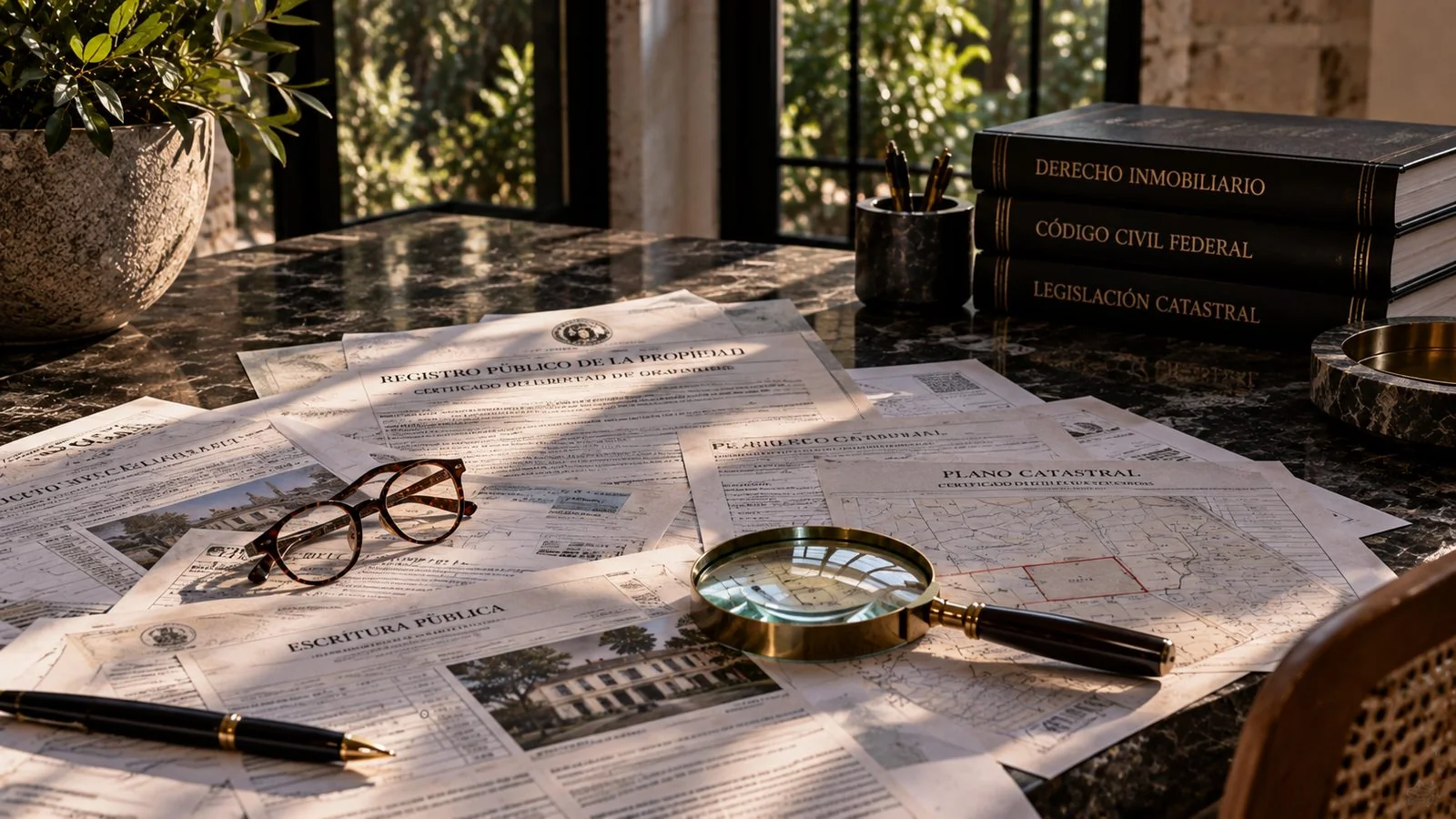
The certificate showing whether a property in Mexico carries a mortgage, a seizure order or a legal claim costs around 800 pesos and takes a few days. In the standard Mexican transaction nobody requests it until after the buyer has signed a promissory agreement and paid a deposit of five to ten percent — the point at which finding something stops being useful and starts being expensive.
We run the checks first. Title chain, encumbrances, the seller's authority to sell, agrarian status, permits and condominium debts — examined while your options are still open, and set out in writing so you can act on what they say.
Turnaround
Three business days from
documents to written findings.
Coverage
Anywhere in Mexico.
No travel, nothing to schedule.
Already signed or paid
Tell us. Knowing where you
stand is still worth having.
Tell us about the property
Send us what you have — even if it is only an address. We reply within one business day with what can be checked, how long it will take, and what it costs.
We will reply within one business day with what can be verified on this property, how long it will take and what it will cost. If you are working to a deadline you have not mentioned, tell us now. Nothing you have sent is shared with an agent, a seller or a developer.
The Problem Is the Order
The searches themselves are not in dispute — every competent transaction runs them eventually. What decides whether they protect you is when they happen relative to your money.
The standard sequence
You find a property and agree a price
You sign a promissory agreement
You pay a deposit — commonly 5% to 10%
The notario then examines title
Anything found is now a renegotiation, or a forfeited deposit
With a review first
You find a property and agree a price
We examine title, encumbrances, authority, permits and agrarian status
You learn what is actually there
You sign, renegotiate, or walk away — freely
The deposit is committed against something verified
Everything capable of changing whether you should buy belongs before the signature. What comes after can only change the price.
What We Check
Not a summary of what the seller told us. A written report of what the registries, the municipality and the building's own records actually say.
Title and chain of ownership
Who owns it, how they came to own it, and whether the chain holds — traced back through the transfers. Older properties predating the electronic registry take longer and occasionally need an archive search.
Encumbrances and claims
Mortgages, seizure orders, lawsuits, easements and preventive annotations — the registered charges that determine whether the seller is free to sell.
The seller's authority to sell
Identity, legal capacity, and — where the property came through an estate or is held by several parties — whether the people signing are actually entitled to.
Agrarian status
Whether the land was ever ejido or communal, and if so whether conversion to private ownership actually completed. Verified at the national agrarian registry as well as the state registry — they answer different questions.
Zoning, permits and heritage
Whether the use you intend is permitted, whether what is physically built matches what was permitted, and whether preservation rules constrain what you could change.
Debts that follow the property
Property tax, water and condominium arrears. These do not appear on the encumbrance certificate because they are not registered charges — they surface only if somebody asks the municipality and the administrator directly.
Every one of these searches is public, inexpensive, and available to anyone who asks in time. What the standard transaction does not provide is anybody whose job is to ask early.
How Long It Takes
Most buyers skip this because a seller has put them on a clock. The clock is almost never the real obstacle. We answer enquiries in one business day and the review itself runs in three — inside the window a promissory agreement typically gives you, with room left to act on what it says.
Legal due diligence
3 days
Business days, once we have the documents. Complete written findings report.
Contract review or drafting
2 days
Promissory agreements, purchase contracts, and the terms that actually bind you.
Response to your enquiry
1 day
One business day, in English or Spanish. Working to a 72-hour deadline? Tell us when you write and we will treat it that way.
If the documents are incomplete — which is common — we will tell you what is missing and what it means, rather than reporting on a partial file as though it were whole.
What This Looks Like in Practice
The first is what late due diligence costs the buyer. The second is what independent due diligence is actually for.
Case one — the check nobody ran
A family put a house on the market that they had inherited from their mother. The broker handling the sale ran no legal due diligence, which is ordinary: it is not something brokers customarily do, it is lawyers' work, and nobody had engaged a lawyer to do it.
A buyer came forward. The price was negotiated and agreed. The problem appeared at the notary's desk — a defect in how the property sat at the Registry, inherited along with the house. It could be corrected. Correcting it would take months.
The buyer would not wait, and withdrew. The family waited several more months and sold to somebody else.
The buyer is the one to watch here. He lost the property he had chosen and the weeks he had spent getting to that desk, and he learned nothing he could not have learned in three days, before he had agreed a single term.
Case two — the answer that ended the engagement
A client was being brought into a real estate project in Tulum as a partner. The seller maintained that everything was in order, and had documents to support it.
We searched the record, and then went past the record: we put the question to a judge in Quintana Roo. The land sat inside a reserve. The criteria were not ambiguous — a project of that kind would never be authorised there, whatever the file appeared to say.
We told him not to buy.
That advice ended the engagement and everything that would have followed from it. It is also the only reason the opinion was worth anything to him. Nothing we are paid improves when a purchase goes ahead.
What You Receive
Full buyer representation is charged at 2% of the acquisition budget you set at the outset. Where the review is taken on its own, we put the scope and the figure in writing before anything starts.
Where We Work
Legal due diligence and contract review are available anywhere in Mexico. Title and registry searches, the national agrarian registry, municipal zoning and permit records, condominium documents and arrears, and the contracts themselves — obtained and reviewed without anybody needing to be in the room.
Technical inspections — we send the team to the property, nationwide. We tell you what that adds before you decide.
Full representation — search, viewings, negotiation and closing — is available across the country. We are based in Mexico City and we handle the whole process, wherever the property is.
Questions People Ask
The notario examines title, confirms identity and capacity, calculates the taxes and registers the deed. That work is obligatory and reliably done — but it happens at closing, and it does not extend to obtaining the building's accounts, comparing construction permits against the structure, or searching the agrarian registry unless the transaction obviously calls for it. They are also required to be neutral between you and the seller.
Not necessarily, and it is worth finding out where you stand rather than waiting. Depending on what the contract says and what the review finds, there may be room to renegotiate, grounds to require a defect be resolved before closing, or a decision to make about the deposit. What does not help is discovering it at the notary's desk.
Ideally the existing deed, the registry reference, the seller's details and whatever contract or draft you have been given. If you have less than that, send what you have — part of the work is obtaining what is missing.
Then it needs verifying at two registries rather than one. Just over half of Mexico's territory is communally held land, and only a small fraction has completed conversion to private ownership — concentrated in exactly the coastal and tourist areas foreign buyers look at. A parcel that never completed conversion cannot lawfully be sold to a foreigner, whatever documents exist.
If that is what the findings support, yes. Our fee is agreed before we start and no part of it comes from a seller, an agency or a developer, so there is nothing in how we are paid that improves when a purchase goes ahead.
Get Started
You will know what can be verified, what it costs and how long it takes before you commit to anything. And if the review is not worth doing on this property, we will say so.
Ready when you are
Use the form at the top of this page, or reach us directly.
Direct contact
Go to the Form ↑ Message Us on WhatsApp